


 contact@icitech.net
 0356087075

 VI
VI
 EN
EN
 JA
JA

Case Study: Transforming Storm Restoration operations through Unified CRM & Roof Drawing Automation
 16 March 2026
The Operational Crisis in High-Volume Restoration
In the high-stakes sector of storm restoration, operational architecture is the silent determinant of a firm’s valuation and scalability. For most roofing enterprises, the transition from local contractor to regional powerhouse is thwarted not by a lack of field crews, but by the "Administrative Cap." This cap is the mathematical limit of administrative throughput—the point where a company's growth is literally throttled by the number of disjointed spreadsheets a human can manually manage before data integrity collapses.
High-performing organizations recognize that their true backbone isn't just trucks and crews; it is a "Hidden Architecture" consisting of a centralized API layer and relational databases that mirror physical operational reality. Without this digital mirroring, seasonal demand surges create extreme back-office bottlenecks, leading to margin erosion and lost visibility.
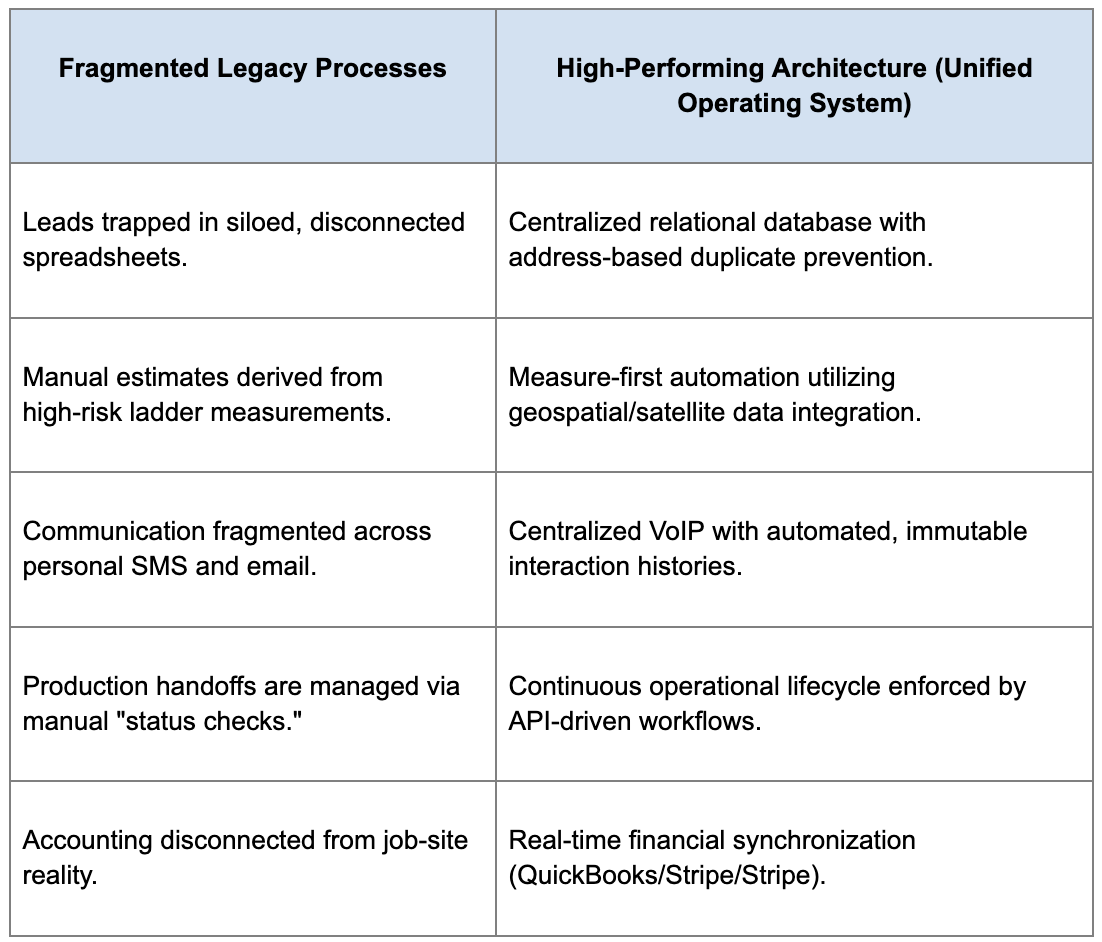
The Strategic "So What?": Failing to unify these systems creates "operational friction" that becomes fatal during peak storm seasons. When the back office cannot process approvals and material orders at the same velocity as the sales force, the business is forced to trade profit for administration. To scale, firms must pivot from manual labor to a "Roofing Operating System" that enforces data-tagging protocols and eliminates the administrative bottleneck.
2. Intelligent Lead Capture & The CRM Pipeline
Lead management is the revenue lifecycle's "first knock." In a saturated restoration market, competitive advantage is secured through intelligent geographic targeting—mapping active storm paths and wind-speed impact radii to locate high-probability insurance jobs. A sophisticated architecture ensures that this data is not just captured, but verified through a "Lead Verification Checklist" before it ever enters the production pipeline.
The architecture enforces data integrity by utilizing specific property address data to mandate duplicate prevention, ensuring sales efforts are never wasted on existing files. By integrating GPS and map views, the system enables precise territory management, allowing leadership to organize canvassing efforts and eliminate the "lost visibility" that occurs when reps operate in silos.
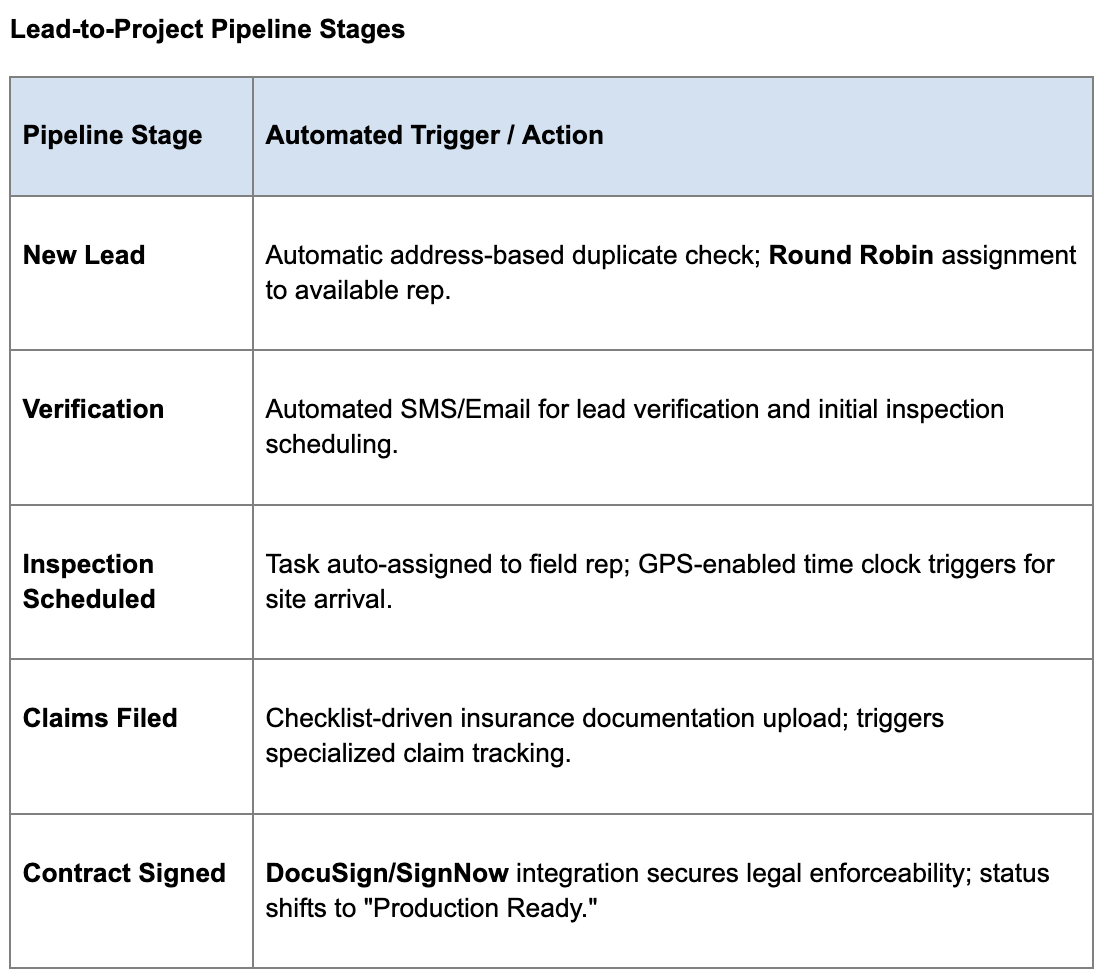
By storing every VoIP call recording, text, and email within the client profile, the system ensures the "history of the promise" is transparent. This visibility eliminates lead abandonment and prepares the organization for the technical precision of the measurement phase.
3. Technical Spotlight: Roof Drawing & EagleView Integration
Strategic leaders prioritize "Measure-First Automation" as a dual-lever for profit protection and risk management. By integrating EagleView directly into the project architecture, firms eliminate the necessity of climbing ladders, which serves as a significant Worker’s Comp and Liability Risk Mitigation play. Precision is moved from the rooftop to the cloud.
The drawing module captures granular technical specifications—including eaves, rakes, ridges, and valleys—and stores them as structured data within the project file. This architecture then mandates the following technical outcomes:
Automated Material Calculations: Derived directly from geospatial specs to eliminate human error.
Labor Estimate Precision: Calculated based on specific roof complexity and pitch.
Customizable Waste Percentages: Tailored to specific layouts to protect margins against material overages.
Efficiency & Risk Comparison
Manual Measurement: Requires site visit, ladder setup (insurance risk), and manual data entry. Total time: 1–2 hours.
EagleView Integrated Drawing: Aerial specs pre-populate estimate templates. Total time: 5–10 minutes.
This technical precision allows a single-interface sales force to close deals at the door. When a homeowner is presented with a professional, data-backed estimate within minutes of an inspection, the window for competition is effectively shuttered.
4. Seamless Backend Operations: From Order to Install
The handoff from sales to production is traditionally where roofing companies lose the most margin. High-performing architecture mandates that an approved estimate automatically triggers the production lifecycle, ensuring that "the promise" made at the door is technically and financially identical to the job performed in the field.
Upon digital signature via DocuSign/SignNow, the system enforces a "Production Ready" status, triggering the following automated workflows:
Work Order Generation: Scope, materials, and crew assignments are auto-populated from the measurement data.
Material Order Automation: POs are sent directly to preferred suppliers (e.g., SRS) based on real-time catalog pricing and availability.
Inventory Management: The system automatically updates inventory levels based on parts usage, allowing the Admin to monitor job costs and consumption in real-time.
In this model, the "Super-User" acts as an operational conductor, overseeing supplier relationships and reordering processes through a single interface. Crucially, this architecture allows one rep to own the promise end-to-end. This continuity is not just an efficiency gain; it is a Customer Retention and Referral Strategy that builds the deep trust necessary for a high-volume business to thrive.
5. Financial Synchronization & The "Lean Office" Result
The ultimate competitive advantage of a unified architecture is the elimination of manual reconciliation. By connecting the operational lifecycle directly to QuickBooks and Stripe, the "Lean Office" becomes a reality. Invoices are generated directly from work orders, and progress billing is automated based on project milestones.
This system enforces a "Profit-First" financial philosophy. Rather than paying commissions on top-line revenue—a practice that often rewards low-margin sales—the architecture tracks and pays commissions on gross profit. This transforms sales reps into stakeholders who are personally invested in the company's bottom-line health.
By implementing this specific "Hidden Architecture," Heritage Construction achieved a landmark operational shift: they successfully scaled from 35 million in revenue with 17 office staff** to over **50 million with fewer than four office staff. This was achieved through measure-first automation and a single-interface sales force, proving that technical architecture—not headcount—is the key to scaling without overhead.
In conclusion, the next generation of roofing leaders will be defined by their ability to deploy technology that reflects operational reality. By unifying sales, production, and finance through a centralized API and relational database, firms can finally break the Administrative Cap, scale instantly with storm demand, and maintain a lean, high-margin organization in any season.






0 Bình luận